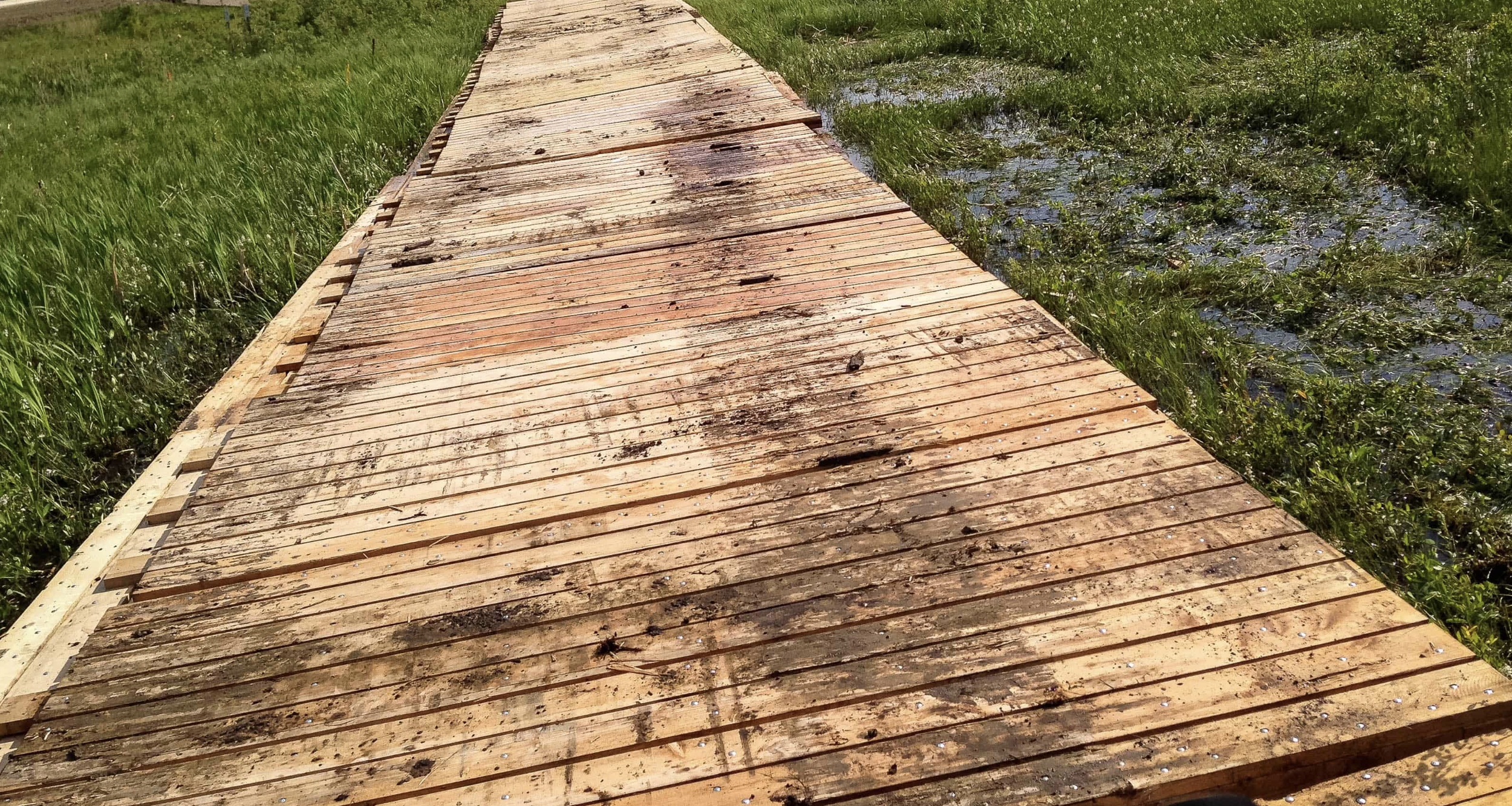
Environmental & Wetland Access Mats
Low-Impact Ground Protection for Sensitive Terrain and Light-to-Medium Equipment
Overview
Our softwood access mats are engineered for use on wetlands, marshes, muskeg, forest floors, restoration sites, and other environmentally sensitive ground conditions. They provide a lighter, lower-impact alternative to traditional hardwood crane mats and are suitable for projects where soil preservation, mobility, and cost efficiency take priority over heavy-lift capacity.
Primary Advantages
Minimal Ground Disturbance
Designed to preserve topsoil, vegetation, and subgrade structure. Reduces rutting and erosion and lowers the cost of post-project remediation.
Lower Handling and Transport Cost
Softwood mats are significantly lighter than hardwood crane mats, enabling faster installation, easier repositioning, fewer trucking requirements, and reduced mobilization cost.
Suitable for Light and Medium Equipment
Appropriate for ATV/UTV traffic, light excavators, skid steers, service trucks, forestry machinery, and utility vehicles operating on soft or fragile terrain.
Rapid Deployment and Removal
Reduced weight improves handling efficiency. Crews can install and remove mats quickly, which benefits projects with short access windows, remote locations, or limited manpower.
Reusable and Modular Construction
Mats can be drilled and fitted with steel rods or cables for rigging, bundling, loading, and transport. This supports repeated reuse across multiple sites.
Applications
Wetlands and Environmentally Sensitive Areas
Temporary access paths, low-pressure equipment routes, staging pads, and ground-stabilization surfaces where soil integrity is critical.
Forestry and Back-Country Access
Short-term work platforms, logging paths, remote-camp access, and timber-harvest corridors requiring minimal disturbance to forest floors and root systems.
Utility, Pipeline, and Civil Work
Support for rubber-tired vehicles, light excavators, and service trucks; temporary roads; staging areas; and renewable-energy pad access. Appropriate when hardwood crane mats are unnecessary.
Restoration and Conservation Projects
Peatlands, marsh restoration, revegetation zones, and other ecologically constrained work areas requiring controlled ground pressure and reversible impact.
Operational Benefits
Reduced soil compaction and surface deformation.
Appropriate strength-to-weight ratio for non-crane applications.
Lower logistics burden: more mats per load, lower fuel use, and reduced freight cost.
Efficient for short-duration or rotating-site projects requiring repeated deployment.
Suitable for greenfield sites, remote terrain, and areas without established access roads.
Easier to maneuver in tight or variable terrain due to reduced mass.
“Not every project demands a hardwood crane mat. In sensitive terrain and light-to-medium-duty operations, a lighter, lower-impact mat is the correct tool. Our softwood Eco-Access Mats provide stable footing where you need it — and minimal ground disturbance where it matters.”
Our products are called different things to different people from different areas.
General Access / Ground Protection
Access mats
Ground protection mats
Ground mats
Construction mats
Temporary roadway mats
Site access mats
Worksite mats
Work pads
Equipment mats
Temporary access panels
Environmental / Low-Impact
Eco-mats
Environmental access mats
Low-impact mats
Sensitive-terrain mats
Habitat protection mats
Marsh mats
Wetland mats
Bog mats
Peatland mats
Forestry / Backcountry
Timber mats
Softwood timber mats
Logging mats
Forestry mats
Swamp mats
Bush mats (regional Canada)
Pipeline / Utility / Civil
Pipeline mats
Utility access mats
ROW (right-of-way) mats
Corridor mats
Pad mats
Service-road mats
Light/Medium Duty
Light-duty mats
Medium-duty mats
Trackway mats
Pathway mats
Vehicle access mats
Equipment-path mats
Traditional Heavy Mats (Not Included in Inventory)
Rig mats
Crane mats
Bridge mats